The Case for Continuous Penetration Testing
Frank writes about vulnerability management, patch operations, and Microsoft-native security workflows.
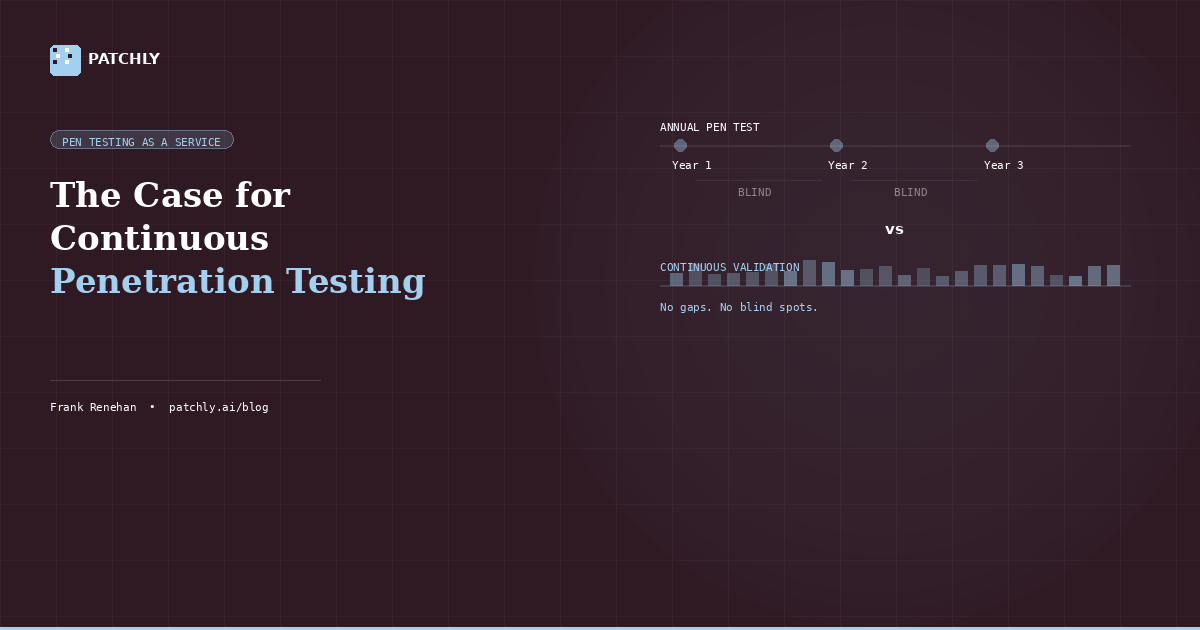
If your organization conducts penetration testing once a year, you’re making security decisions based on data that’s up to 364 days old. For most of the year, you don’t actually know your current security posture – you know what it looked like the last time someone checked.
In a static environment, that might be an acceptable trade-off. Most environments aren’t static.
The gap is bigger than you think
The standard argument for annual pen testing goes something like this: we test once a year, we remediate the findings, we stay compliant, we move on. It’s a reasonable framework if your environment is stable and your risk profile doesn’t change much between tests.
But consider what actually happens in a typical twelve-month window. New infrastructure gets deployed. Cloud workloads spin up and down. SaaS applications get connected to core systems. Staff change, configurations drift, and certificates expire. Each of these events potentially changes your exposure – and none of them trigger a retest.
I supported a client through a significant cloud migration some years ago. They’d done a thorough pen test shortly before the migration began – sensible timing. Their next scheduled test was nine months after the migration completed. The two environments were fundamentally different, but the testing cadence hadn’t adjusted to reflect that. The annual calendar event had become decoupled from the actual risk cycle.
Fast-moving environments compound the problem
Here’s the counterintuitive part: the more sophisticated your engineering practice, the more exposed you are to the annual testing gap.
A client with a mature IaC environment – Terraform, Ansible, rapid service iteration – was continuously reshaping their infrastructure. Old services were being deprecated and rebuilt. New endpoints were appearing as part of the normal development cycle. Their exposure profile was changing week to week, sometimes day to day. An annual pen test in that environment isn’t a security control – it’s a historical document.
The teams doing the most to modernize their infrastructure are often the ones whose testing cadence is least suited to the pace of change. That’s a gap worth closing.
What continuous testing actually means
PTaaS combines continuous automated scanning with human-led testing – the always-on coverage of tooling with the expert judgment and creative attack thinking that no scanner can replicate. Automated scans run continuously against your defined scope, surfacing new findings in near real-time. Human testers validate, contextualize, and go deeper where the tooling flags something worth investigating.
With Patchly Validate, engagements include a baseline of four hours of human testing per month. That time can run as a regular monthly cadence or be batched strategically – concentrated around a major infrastructure change, a cloud migration, or ahead of an audit. The automated layer runs regardless, so coverage never drops to zero between human sessions.
The practical effect is that you’re not waiting eleven months to discover that a new service was misconfigured at deployment. You’re finding out within days – or hours – while the context is still fresh and the fix is straightforward.
Remediation you can actually verify
One of the most underappreciated problems with annual pen testing is that tracking remediation progress over a twelve-month cycle is nearly impossible. By the time the next test runs, you’re relying on spreadsheet updates and self-reported status fields to understand what actually got fixed.
Continuous testing replaces that with verified, timestamped data – findings that are confirmed resolved because they’ve been retested, not because someone updated a status field. We covered this in more detail in Finding Vulnerabilities Is Easy. Proving You Fixed Them Is the Hard Part.
The Scan Diff as a continuous improvement tool
The piece that makes continuous testing genuinely useful – rather than just more frequent noise – is structured comparison across assessments. With Patchly Validate, every scan is automatically compared against the previous baseline. Findings are categorized as new, resolved, persistent, or changed.
That categorization turns testing from a periodic checkpoint into a continuous improvement loop. You can see whether your remediation efforts are actually moving the needle, which finding types keep recurring, and where your environment is drifting between cycles. That’s a fundamentally different conversation than “here’s what we found this year.”
A note on cost
Annual pen tests from reputable firms aren’t cheap – and they shouldn’t be. Expert-led testing has real value. But the cost model of a single large annual engagement versus ongoing continuous coverage is worth examining carefully, particularly for organizations whose environments change frequently.
The question isn’t just what you pay – it’s what you get for that spend in terms of actual coverage across the year. A single snapshot, however thorough, covers one day. Continuous validation covers all of them.
Related reading: Finding Vulnerabilities Is Easy. Proving You Fixed Them Is the Hard Part. | Your Attack Surface Is Bigger Than You Think
See how Patchly Validate combines automated scanning with human-led testing across continuous assessments. Download a sample report or book a demo to walk through what this looks like in a real environment.
In this article
Want to see how Patchly works? Request a free assessment or book a demo.